Securing the Future: Why Quantum Security Must Be a Strategic Priority for Businesses

As quantum computing transitions from theoretical research to real‑world capability, the cybersecurity landscape is entering a new era. Today’s encryption standards, underpinning everything from financial systems to national infrastructure, are poised to be vulnerable to quantum‑enabled attacks. Forward‑thinking organisations must act now to safeguard data, trust, and business continuity.
Singapore’s National Quantum Strategy: A Turning Point
In May 2024, Singapore announced its National Quantum Strategy (NQS), a national roadmap supported by nearly SGD $300 million under the Research, Innovation and Enterprise (RIE 2025) plan- designed to accelerate quantum research, ecosystem growth, and industry readiness over the next five years. This investment builds on more than S$400 million of foundational funding since 2002 aimed at strengthening Singapore’s position as a global quantum hub. CQT
The NQS is driven by the National Quantum Office (NQO), a central coordinating body hosted by Singapore’s Agency for Science, Technology and Research (A*STAR), and guided by the National Research Foundation (NRF). It brings together public research institutions, industry partners, and international collaborators to develop quantum technologies – including quantum computing, sensing, and secure communications. NQO
Quantum Threats to Current Security Paradigms
Quantum computing’s potential to solve certain mathematical problems exponentially faster than classical computers has enormous scientific and commercial promise. However, it also means that many widely used cryptographic systems, such as RSA and ECC, could become obsolete once sufficiently powerful quantum hardware is realised.
This creates a pressing “harvest now, decrypt later” risk: attackers could collect encrypted data today with the intent of decrypting it in the future once they have access to quantum decryption capabilities. For sectors handling long‑term sensitive data, such as finance, healthcare, government, and critical infrastructure, the consequences could be severe.
The Business Case for Quantum‑Safe Security
Quantum security isn’t just a technical issue; it’s a business imperative. Organisations that fail to anticipate and mitigate quantum threats now risk regulatory non‑compliance, catastrophic data breaches, operational disruption, and loss of stakeholder trust.
Key pillars of a quantum‑ready security posture include:
📌 Post‑Quantum Cryptography (PQC)
Algorithmic replacements for classical cryptographic schemes designed to resist both classical and quantum attacks.
📌 Quantum Key Distribution (QKD)
Quantum physics‑based techniques that enable secure key exchange with provable security grounded in the laws of nature—not computational difficulty.
📌 Integrated Quantum Security Platforms
Solutions that combine PQC, QKD, and traditional cybersecurity measures to create resilient, end‑to‑end protection across networks, data at rest, and communications.
Singapore’s Strategic Position and Industry Readiness
Singapore’s NQS reflects a comprehensive national strategy to elevate scientific excellence, strengthen engineering capabilities, foster talent, and catalyse innovation partnerships. Under the strategy, national programmes such as the National Quantum Computing Hub (NQCH) and collaborations with global quantum companies will drive applied research and industry‑focused outcomes, including secure quantum communications trials and testbeds. CQT
In addition to fostering research, initiatives like Singapore’s National Quantum‑Safe Network Plus (NQSN+), launched under the Digital Connectivity Blueprint, are already enabling practical demonstrations of quantum‑safe technologies such as QKD in network environments, building momentum for broader commercial adoption. Infocomm Media Development Authority
For corporates and government agencies, Singapore’s proactive strategy is a model of how national coordination can accelerate both capability building and risk mitigation.
What This Means for Your Organization
Quantum‑safe readiness should be on every C‑suite agenda. Waiting until quantum hardware reaches full break‑capability is too late; the transitional risk window is now. Businesses should:
✅ Evaluate existing cryptographic assets and data lifecycles
✅ Prioritize deployment of PQC and QKD where risk exposure is highest
✅ Engage with ecosystem partners to pilot quantum‑safe solutions
✅ Build internal expertise and governance frameworks around quantum security
How Squareroot8 Can Help
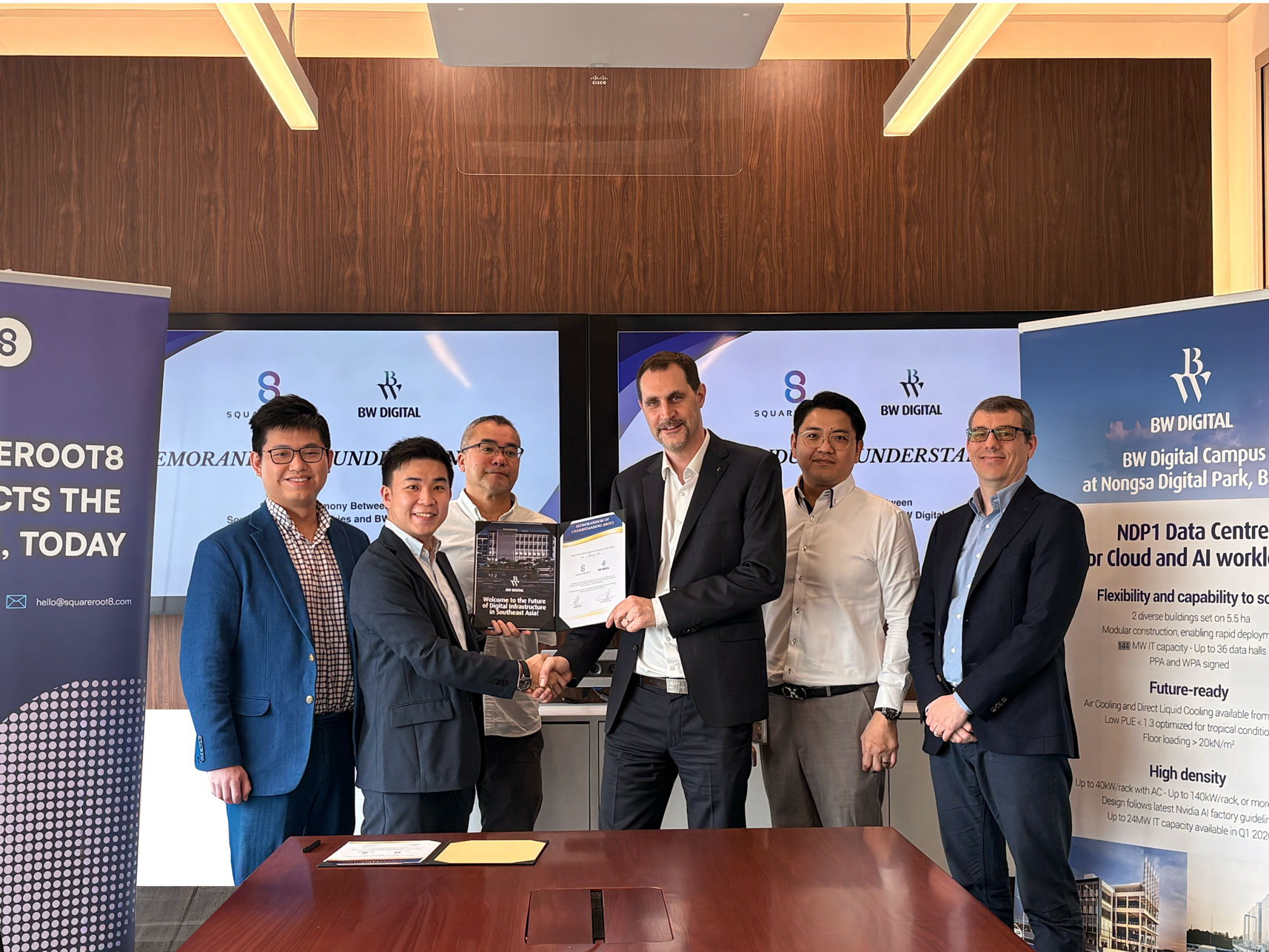
At Squareroot8, we specialise in guiding enterprises and public sector organisations through the quantum security transition. Our solutions blend post‑quantum cryptography, quantum key distribution, and advanced cybersecurity practices to deliver resilient, future‑ready infrastructures.
Leading Quantum Security: Squareroot8 Protects the Future, Today.